Why Gamification Fails in Edtech (and What Works Instead)
Points, streaks and badges optimize for engagement, not learning. Why that backfires for kids, where game ideas do help, and what to build instead.
I have kept a streak in a language app for longer than I would like to admit, and at some point I noticed something embarrassing: I was no longer learning the language. I was protecting the streak. I would open the app at 11pm, do the easiest possible lesson, watch the little flame survive another day, and go to bed feeling oddly accomplished. If that can happen to a grown adult who builds software for a living and knows exactly what the app is doing, imagine what it does to a twelve year old. Points, streaks and badges are everywhere in educational products, and they are often sold as the secret to making learning fun. Having built a learning app and watched my own middle schooler use plenty of others, I have come to believe most gamification in edtech solves the wrong problem.
What points, streaks and badges actually optimize
Every product team needs numbers to steer by. The easy numbers are engagement numbers: how many kids opened the app today, how many minutes they stayed, how many came back tomorrow. Those are simple to measure, they move quickly, and they make a great chart in a meeting.
Learning is the opposite. It is slow, lumpy and hard to measure. Did a child actually understand ratios better this month? Will they remember it in spring? Those questions take real effort to answer.
So, quite naturally, products drift toward what they can measure. Points, streaks and badges are extremely effective at moving engagement numbers. That is precisely the problem. There is an old principle often called Goodhart's law: when a measure becomes a target, it stops being a good measure. Time in the app was supposed to be a rough sign of learning. Once you design to maximize it, it becomes a sign of nothing except time in the app.
It is like judging a restaurant by how fast plates leave the kitchen. Speed is easy to count. You will get very fast plates. You will not necessarily get good food.
The overjustification effect
There is a well-studied idea in psychology called the overjustification effect. When you give people an external reward for something they already enjoy, their reason for doing it can shift from "I like this" to "I get paid for this." Then, when the reward goes away, the interest often goes with it.
Picture a kid who loves to draw. Start paying them a dollar per drawing, and for a while you will get a lot of drawings. Stop paying, and they may well draw less than they did before you started. The activity got relabeled in their head as work.
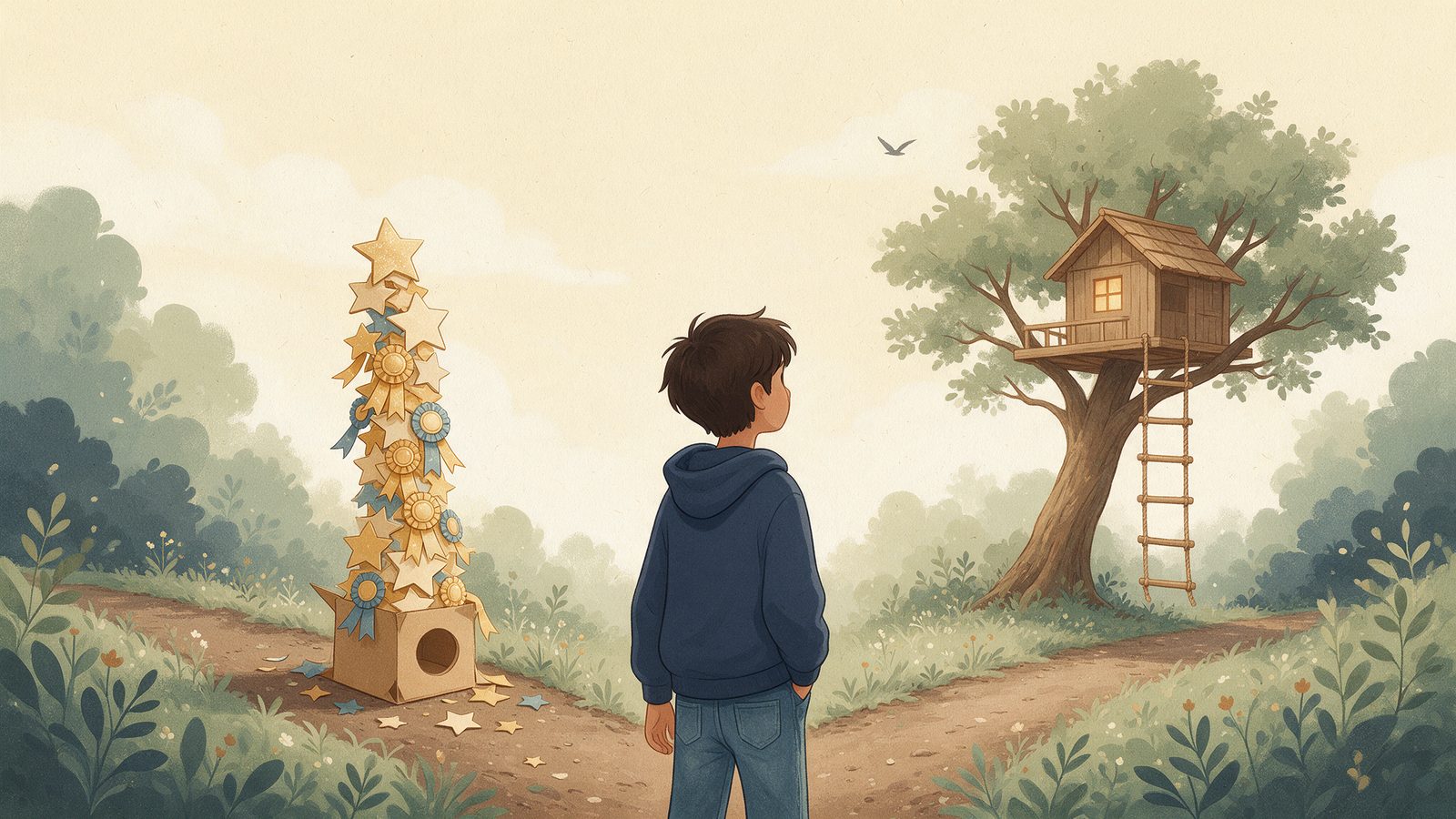
Learning has the same vulnerability. Curiosity is the most valuable thing a child brings to school. Wrapping every bit of learning in points risks teaching kids that the point of reading or solving a problem is the reward that follows. That is a terrible lesson to accidentally teach, and a hard one to undo.
Two ways it backfires in practice
Gaming the system
Kids are brilliant optimizers. Give them a scoring system and they will find the cheapest path to the score, usually faster than the designers expected. I watched my middle schooler figure out within a day that in one app, a wrong answer cost nothing and a fast guess was quicker than thinking. Guess, guess, guess, points, points, points. The app recorded a very engaged learner. The learner was learning to guess.
Other common tricks: repeating the easiest lesson for points, skipping the reading and jumping to the quiz, or picking the lowest difficulty because it pays the same. None of this is cheating in a moral sense. It is a perfectly rational response to the rules. If a metric can be hit without the skill, it will be.
Streak anxiety
Streaks deserve their own warning. A streak is built on loss aversion: the pain of breaking it is meant to pull you back. That works, but at a cost. It turns learning into an obligation and a day off into a failure.
I have seen a kid worry about a streak on a sick day, on a family trip, on a night when the honest and healthy choice was to go to sleep. That is backwards. Rest is part of learning. Spaced repetition, one of the most reliable techniques we know, actually depends on gaps between practice sessions. A good learning rhythm has breathing room in it. A streak treats breathing room as a crime.
Where game ideas genuinely help
I want to be fair, because games themselves are wonderful, and some game ideas belong in learning products.
- Getting started. A small celebration on day one can help a kid over the hump of trying something new.
- Honest feedback loops. A progress bar that reflects real progress toward a real skill is useful information, not manipulation.
- Drill where speed is the skill. For things like math facts, where quick recall genuinely matters, a timed game can be well aligned with the goal.
- When the game is the learning. The best educational games are ones where playing well requires the skill itself: a puzzle you can only solve by understanding the math, a simulation you can only win by reasoning about cause and effect. There is no gap between the game and the lesson to exploit.
- Fun matters. A learning experience that is joyless will not be used. Delight is not the enemy. Misaligned rewards are.
The test I use is simple: could a kid max out this reward without getting better at the skill? If yes, the reward is decoration at best and a trap at worst.
What works instead
So what do you build if not points? Here is what I have seen motivate kids in a lasting way, mostly drawn from self-determination theory (Deci and Ryan) and from mastery learning.
Visible progress in real skills. "You can now solve two-step equations" means far more than "450 XP." Name the skill. Show the ladder of skills ahead, and which rungs are done.
Autonomy. Let kids choose what to practice next, in what order, or which kind of example they want. A little choice goes a long way toward making the work feel like theirs.
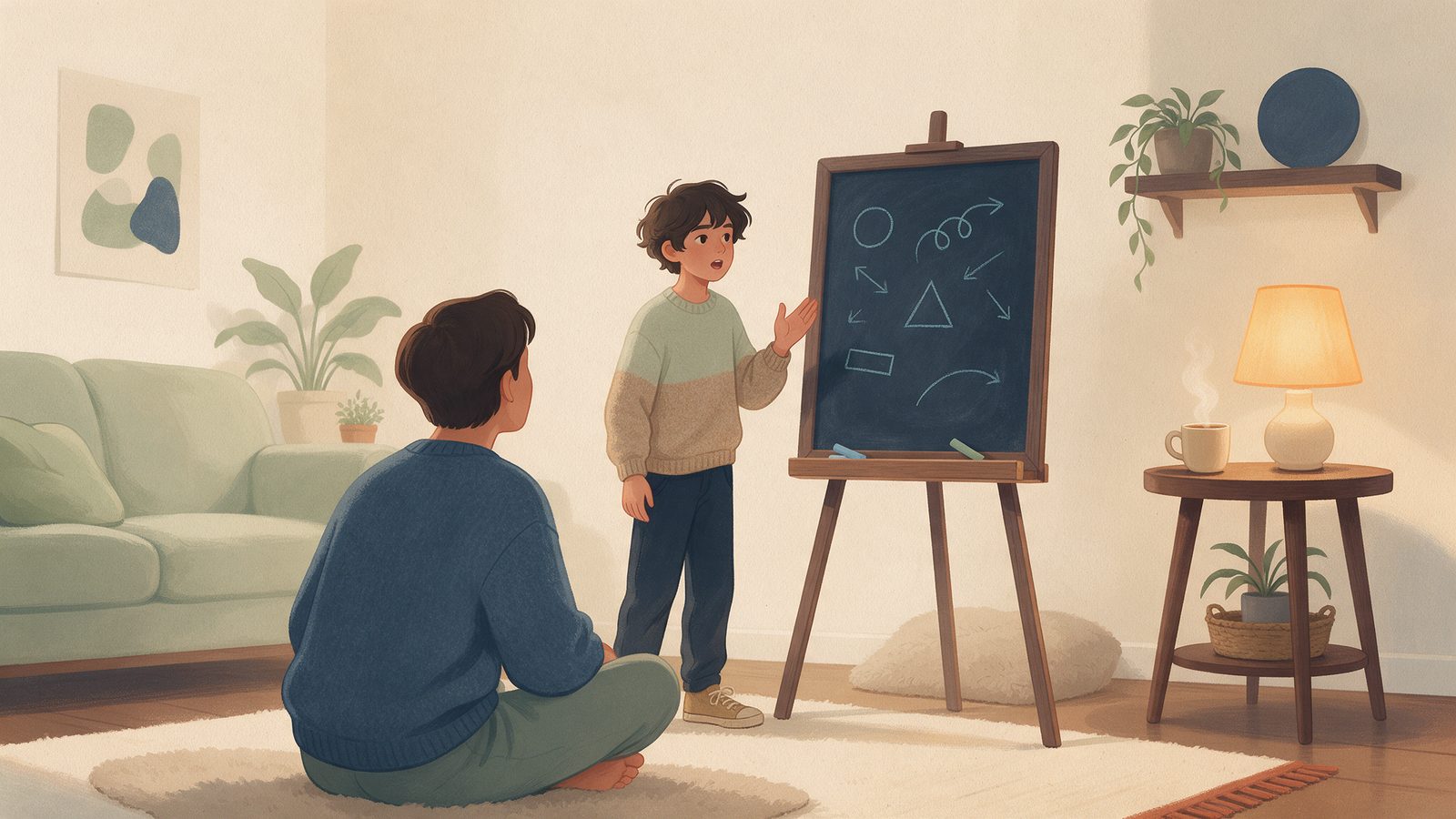
Mastery, and the "I can do this now" moment. The single most motivating thing I have watched happen at our kitchen table is my kid looking at a problem that stumped them a few weeks earlier and solving it without help. Showing kids that before and after is more powerful than any badge.
Social meaning. Explaining a solution to a parent, helping a sibling, or building something another person actually uses. Learning that matters to someone else matters more to the learner.
Gentle consistency instead of streaks. Weekly goals, forgiving rhythms, and no penalty for a day off. Consistency is good. Fear of losing a number is not.
Takeaways
For parents:
- Notice whether your kid talks about points or about what they can now do. That tells you what the app is teaching.
- Turn off or ignore streaks if they cause stress. Rest is part of learning.
- Celebrate the "I can do this now" moment out loud.
For builders:
- Ask of every reward: can it be earned without the skill? If so, redesign or remove it.
- Measure learning, not just engagement, even when it is harder.
- Replace streaks with forgiving weekly rhythms.
- Show real skills mastered, and give kids meaningful choices.