Teach-Back: The Life Skill Hiding Inside Homework
Explaining a solved problem to someone else is one of the best ways to learn. Here is how to make teach-back a simple, low pressure habit at home.
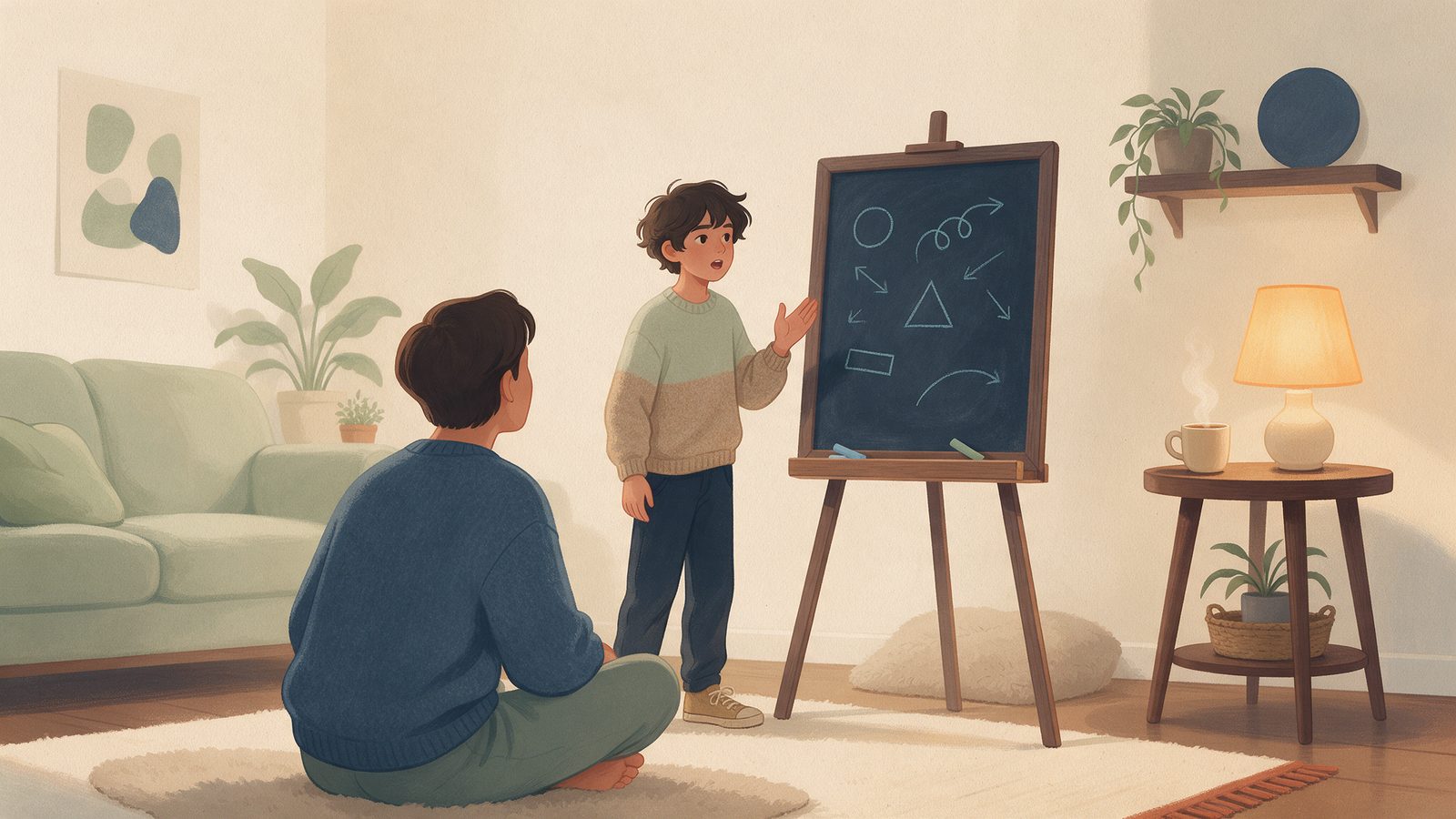
The most useful question I have learned to ask my middle schooler is not "did you finish your homework?" or even "do you understand it?" Kids, being reasonable people, answer those with "yes" and get on with their lives. The question that actually tells me something is this one: "Teach me how you would solve this one." It flips the roles. I become the student, they become the teacher, and within about two minutes we both know exactly what they understand and exactly where it gets fuzzy. It is cheap, it takes no special training, and it turns out to be one of the most powerful learning habits I know. It is also a life skill hiding inside ordinary homework.
Why explaining works
There is a well-known idea in learning research called the protégé effect: people often learn material better when they expect to teach it, and better still when they actually do. The reasons are not mysterious once you think about them.
When you explain something, you have to put the steps in order. You cannot wave your hands past the confusing part, because your listener will ask what you mean. You have to find words for ideas that were only half formed in your head. And you get immediate feedback on your own understanding, because the moment you cannot explain a step, you know you do not really have it yet.
Software engineers have a version of this called rubber duck debugging. When you are stuck on a bug, you explain your code, line by line, to a rubber duck on your desk. Very often, somewhere around line twelve, you hear yourself say something like "and then this value is always positive, because..." and you stop. Because it is not. The duck did not help. Saying it out loud did.
Explaining also forces a kind of retrieval practice. Instead of rereading notes, which feels productive but mostly builds familiarity, your kid has to pull the method out of their own memory and rebuild it in front of someone. That effortful rebuilding is a big part of what makes learning last.
How to do it at home
The trick is to make it feel like curiosity, not an exam. Here is the routine I have settled into, after plenty of trial and error.
- Pick one problem they have already done. Not a new one. You want them on solid ground, explaining something they believe they know.
- Ask to be taught. "Teach me how you'd solve this one" lands very differently from "explain this to me." The first makes them the expert. The second makes them a suspect.
- Be a curious student, not a grader. Nod, follow along, and resist the urge to jump in the moment you spot a mistake.
- Ask why at the key step. Every problem has one step where the real understanding lives. In fraction division, it is the flip. "Why do you flip the second one and not the first?" is worth more than ten questions about the arithmetic.
- Add a twist. Change one thing. "What if this number were negative?" "What if there were three people sharing instead of two?" A twist reveals whether they understand the method or just remember the motions.
- Occasionally make a deliberate mistake. "So then I'd add these two, right?" Kids love catching a parent being wrong, and correcting you requires them to know why it is wrong.
A few things to avoid: correcting every slip instantly, turning it into a pop quiz, or launching into your own explanation the moment they hesitate. Silence is fine. Let them think. If they get stuck, a gentle "what would you try first?" is usually enough.
And keep it short. Five minutes, two or three times a week, beats an hour long session that leaves everyone grumpy.
Why a specific problem beats a whole topic
Early on, I made the mistake of asking big questions. "Explain photosynthesis." "Tell me about ratios." What I got back was a recited paragraph, more or less word for word from the textbook, delivered in a monotone. It told me my kid could remember sentences. It told me almost nothing about whether they could use the idea.
Specific problems work much better, for a few reasons.
- They are concrete. A worked problem has actual steps, and each step either makes sense or it does not.
- They pinpoint the gap. When a kid explains a single problem, the shaky step shows up exactly where it is. When they explain a whole topic, the gaps hide in the vagueness.
- They are less intimidating. "Explain ratios" is a mountain. "Walk me through this one" is a hill a nervous twelve year old can actually climb.
It is the difference between asking a cook to "explain Italian food" and asking them to show you how they make this particular sauce. The second question reveals far more about whether they can cook.
How it builds confidence and communication
Something I did not expect: teach-back changed how my kid talks about school. Being the one who explains, even to a parent, gives a sense of ownership. It is a small, regular reminder that they are capable of knowing things well enough to share them.
It also quietly builds communication skills that matter far beyond math. Explaining a solution clearly is a cousin of presenting an idea in class, pitching a project, or walking a teammate through a plan at work someday. Kitchen table teach-back is low stakes rehearsal for all of that. Kids learn to organize their thoughts, choose words for a listener, and handle a question they did not see coming.
And it teaches an honesty that I value a lot. Sometimes the best answer in a teach-back is "I'm not sure why that step works." Saying that out loud, without embarrassment, is a skill many adults never fully develop. Treat that moment as a win, not a failure. Now you both know exactly what to work on.
What I learned building teach-back into software
In building a learning app, we put teach-back at the center, and it taught me a few things worth passing on to anyone doing the same.
First, kids' explanations are messy. They are short, out of order, and full of words like "you just do the thing." A fair judge looks for the key idea, not polished vocabulary. Penalizing a child for not saying "reciprocal" when they clearly understand flipping the fraction is a fast way to make them hate explaining.
Second, the twist question is where the signal is. Almost anyone can retell the steps of a problem they just solved. Handling a small change shows real understanding.
Third, it must not feel like a test. The moment teach-back feels like grading, kids start performing instead of thinking.
Takeaways
For parents:
- Replace "do you get it?" with "teach me how you'd solve this one."
- Pick a problem they have already finished, and ask why at the one step that matters.
- Add a single twist to check that the understanding travels.
- Keep sessions short and celebrate an honest "I'm not sure."
For teachers and builders:
- Ask for explanations of specific worked problems, not whole topics.
- Judge for the key idea, not the vocabulary.
- Use a twist question as your best evidence of understanding.