The Future of Learning When Every Kid Has a Patient Tutor
When patient explanation becomes cheap, proof of what a child can do alone becomes precious. A grounded look at what changes for kids, parents and teachers.

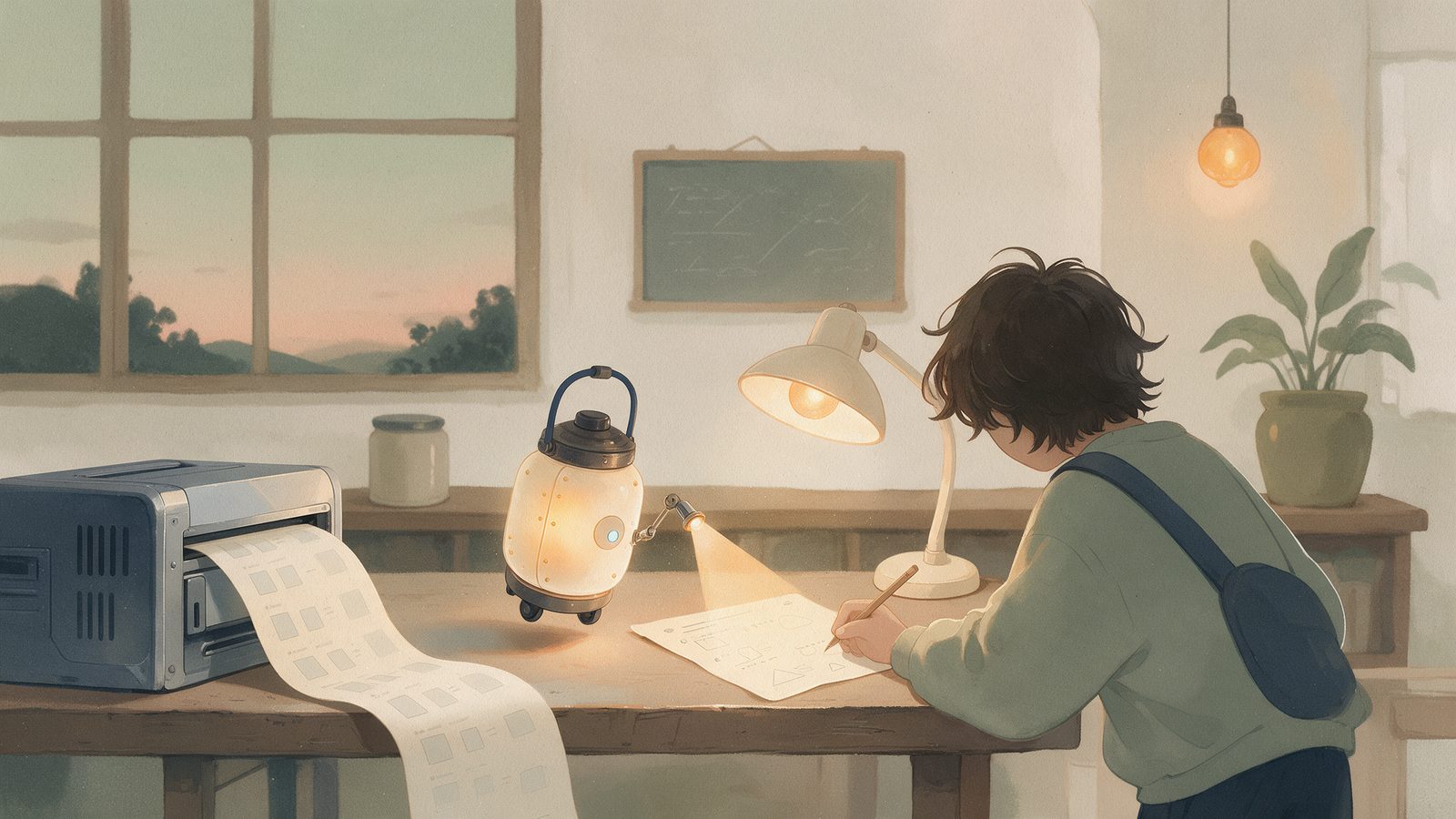
For most of history, a patient one-on-one tutor was a luxury. Royals had them. Wealthy families hired them. Everyone else got a classroom of thirty and a teacher doing heroic work with too little time. That is changing faster than our schools, our habits, or our parenting instincts can keep up with. Very soon, if not already, almost every child with a device will have access to something that can explain long division seven different ways at midnight without losing its temper. I do not think that makes learning obsolete. I think it moves the value somewhere else, and the families and teachers who notice where it moves will be in a much better position than the ones who keep fighting the last war.
The tutor is no longer the scarce thing
Economists have a simple rule of thumb: when something becomes abundant, value shifts to whatever stays scarce. When recipes became free and everywhere, the scarce thing was no longer the recipe. It was the person who could actually make a decent dinner on a Tuesday from whatever was in the fridge. When calculators showed up, the fast mental arithmetic of a human stopped being impressive on its own, and knowing which calculation to do became the skill.
Explanation is going through the same shift. A clear, patient, personalized explanation used to be the bottleneck in learning. It is quickly becoming the cheapest part. So the obvious question for any parent or teacher is: if explanation is cheap, what is expensive now?
My answer, after a lot of evenings watching my middle schooler work and a lot of days building learning software, is this: evidence of what a child can do on their own.
Evidence of independent ability becomes precious
Here is an uncomfortable truth for schools. A piece of homework handed in today could have been done by the student, by a sibling, by a parent, or by a machine, and from the paper alone you often cannot tell which. The worksheet used to be a reasonable proxy for "my kid can do this." It is not anymore.
Sports have always understood this distinction. Practice matters enormously, and coaches help constantly during practice. But nobody confuses a good practice with the game. On game day, the coach is on the sideline, and what the player can do alone is what shows up on the scoreboard.
I expect learning to move in that direction. More of the meaningful evidence will come from moments where help is clearly off: work done in class, problems solved out loud, a short conversation where a student explains their thinking to a teacher. This is not about catching cheaters. It is about knowing what is true. Formative assessment, the practice of checking understanding while learning is still underway, becomes more important, not less, because it is one of the few ways to see the real picture.
For anyone building learning tools, this has a practical implication. Every piece of work should carry a label, at least internally: was this done with help, or without? Those are two very different signals, and blending them produces a progress report that flatters everyone and informs no one.
From recalling to explaining, building and making
I want to be careful here, because there is a popular and lazy version of this argument that goes "kids do not need to memorize anything now, they can just look it up." That is wrong. You cannot think with knowledge you do not have. A child who has to look up every multiplication fact never gets to the interesting part of the problem. Retrieval practice, the simple act of pulling things out of your own memory, is still one of the most reliable ways to build durable knowledge.
What changes is what we ask kids to show. If a machine can recite the causes of a historical event, then reciting them is no longer a strong signal of understanding. Explaining them is. Applying them to a new situation is. Building something with them is.
I see this at home. My kid can read a summary of how a simple circuit works and agree with all of it. But when they actually tried to wire up a battery, a switch and a small light, the gaps in their understanding showed up immediately and very specifically. Making things is honest in a way that reading is not. The light either turns on or it does not.
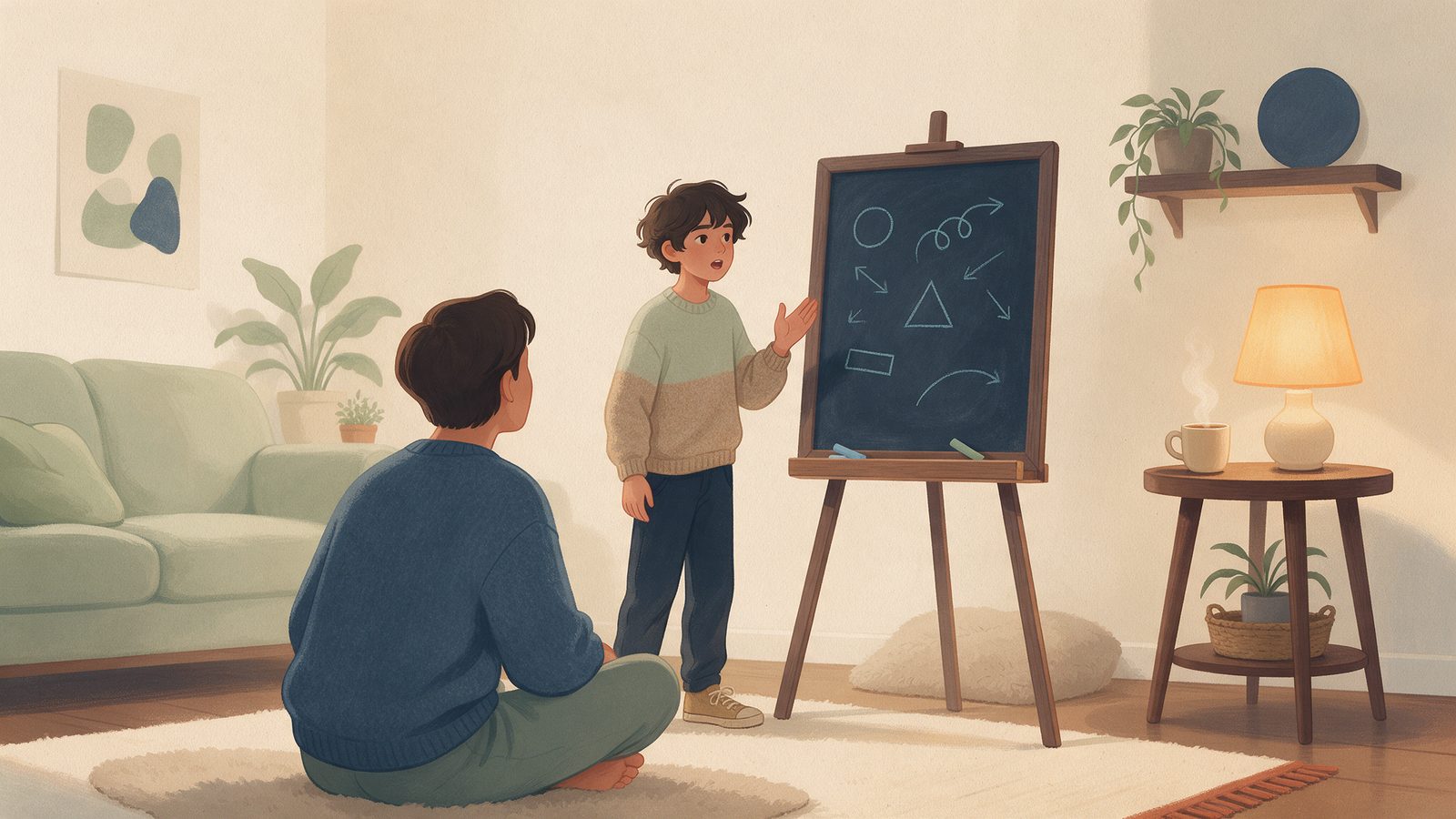
So I expect more learning to look like explaining a solved problem in your own words, building a small project, writing an argument and defending it, or teaching a younger sibling. These are harder to fake and more satisfying to do.
The role of parents and teachers shifts
If machines can handle a lot of explanation, what are the humans for? More than ever, I think.
Self-determination theory, from Deci and Ryan, describes three things people need to be motivated from the inside: autonomy, a sense of choice; competence, a sense of getting better; and relatedness, a sense of connection to other people. A tutor on a screen can help with competence. It is much weaker on the other two. A teacher who knows your name and notices when you are off today, or a parent who asks a genuinely curious question at dinner, supplies something a patient algorithm cannot.
For teachers, I expect the job to tilt toward designing good challenges, judging real evidence of understanding, and building the relationships that make a kid want to try. Less time delivering content, more time coaching.
For parents, the shift is from homework helper to something closer to a coach. You do not need to remember how to factor a polynomial. You need to ask "can you show me how you did that one?", set sensible rules about when the tutor is allowed to help, and model the thing we most want kids to learn: that being curious and being stuck are normal parts of the same process.
What could go wrong
I would be doing you a disservice if I painted this as all upside. A few things worry me.
- Uneven quality. "Every child has a tutor" is only good news if the tutor is good. A tool that just hands out answers is not a tutor, and the gap between thoughtful and careless tools could widen existing inequalities rather than close them.
- Losing productive struggle. If help is always one tap away, kids may never build the tolerance for being stuck that real problem solving requires.
- Isolation. Learning has always been partly social. A child who learns everything alone with a screen misses the arguments, the jokes and the shared confusion of a classroom.
- Data. A tool that knows exactly where your child struggles holds sensitive information. Who sees it, and for how long, matters.
None of these are reasons to refuse the technology. They are reasons to be deliberate about it.
Takeaways
For parents:
- Treat what your kid can do alone, without help, as the real measure of progress.
- Ask for explanations, not just answers: "Teach me how you did this one."
- Encourage making things. Projects reveal understanding that worksheets hide.
- Keep knowledge in heads. Quick, low pressure recall still matters.
For teachers and builders:
- Separate assisted work from unassisted work, and report them differently.
- Design for autonomy and relatedness, not just competence.
- Protect a little productive struggle on purpose. Not every question needs an instant hint.